






Your motorcycle riding gear probably has been made to enhance your safety, you always ride with a helmet, and maybe your motorcycle has ABS. You would almost forget that those measures can only make a small difference in how safe you are, compared with the influence of your own riding behaviour.
Motorcycle riding means that you take full responsibility for your own safety, for instance by learning to anticipate on mistakes of other people on the road. Anticipating mistakes of other people and reacting with the right behaviour is totally different from only thinking that you were right and the other was wrong...
On ths page about safety with respect to motorcycle riding, we try to give some advice on how to enhance your own safety.
 Er is een Nederlandse versie:
http://www.luiemotorfiets.nl/tips/safety/
Different ways to enhance your safety
Safety in gear
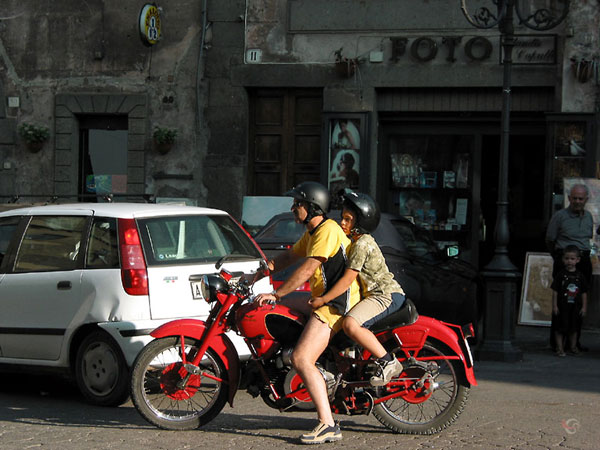
When talking about ways to enhance your safety on a motorcycle, most people think of helmets, knee or elbow protectors, or leather suits.
True, all these things are meant to make you safer. But don't forget that there is a more direct way to enhance your own safety.
Avoiding accidents
You can enhance your safety by doing everything to avoid an accident (primary or active safety), or by making sure that the damage, in case of an accident, is as minimal as possible (secondary or passive safety).
Car versus motorcycle
In fact, the big difference between driving a car and riding a motorcycle, is that in cars, the secondary safety is enormous (the car is a sort of safety cocoon around you), while on a motorcycle, the safety is almost entirely in your own hands (which means primary safety).
We will discuss both forms of safety on this page, but first we will have a look at some figures.
Accidents of motorcyclists: some figures
Research: MAIDS Report
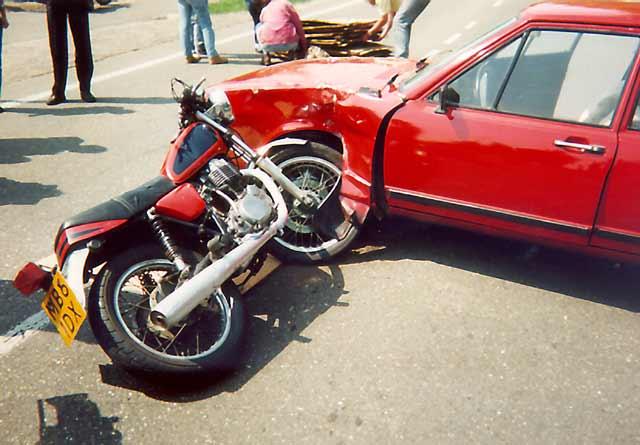
In Europe, researchers have looked in detail at motorcycle crashes, and figures have been compared to figures of "average" motorcyclists (it should be noted that they included scooters and "light" motorcycles as well). This MAIDS-rapport is on-line (you have to register to get the full report, but it's free).
Some of the findings (we will relate to some of these figures in the items below):
1.- In 37% of cases, the primary accident contributing factor was a human error on
the part of the motorcycle rider.
The human error could be lack of attention or lack of skill.
The researchers note that often, the amount of skill needed exceeded the amount of skill that is
needed to pass exams.
Obviously, since skills are the result of practice over time and the exams
are at the beginning of the rider's experience.
2.- Among the secondary contributing factors, motorcycle riders failed to see the other
vehicle and they also made a large number of faulty decisions, i.e., they chose a poor or incorrect
collision avoidance strategy.
Moped riders tended to fail to see the other vehicle more than motorcycle riders,
while motorcycle riders tended to make more faulty decisions.
In 13% of all cases, there was a decision failure on the part of the motorcycle rider (braking too late or
too little, braking where outmanouvring would be better, freezing instead of manouvring, etc).
3.- In 50% of cases, the primary accident contributing factor was a human error on the
part of a car driver.
Often, this has to do with not seeing (or not looking).
4.- In about 1/3 of accidents motorcycle riders and car drivers failed to account for visual
obstructions and engaged in faulty traffic strategies.
This means, for instance, that they didn't
realize there was a blind corner, or that a parked truck bloked their view.
5.- 90% of all risks to the motorcycle rider, both vehicular and environmental, were in front
of the motorcycle rider prior to the accident.
This doesn't mean of course that you don't have to check your mirrors,
but what is in front of you should be observed with great attention.
6.- Among the primary contributing factors, over 70% of the car driver errors were due to
the failure to perceive the motorcycle.
This is the "Sorry I didn't see you" situation.
In most cases, wearing highly visible clothes or carry fancy lights would not help: the car driver did not look at
all, or the motorcycle was hidden behind the blind spots of the car.
7.- The roadway and cars were the most frequently reported collision partner.
In 60% of accidents, the collision partner was a passenger car.
The roadway as "collision partner" of course, means that there was a one-sided accident, with only the motorcycle
(or moped) rider involved. Ride too hard (with respect to ones capabilities) in a corner is for instance often a
cause of these kind of accidents.
Passenger car here, means a car which is not a truck, bus or van: it doesn't mean that there were actually
passengers in the car beside the driver.
8.- There were motorcycle technical problems in less than 1% of the accidents.
Most of these were related to the tyres.
Meaning, of course, that you should regularly check your tyres for possible punctures...
9.- In 18% of all cases, motorcyclist's traveling speeds were greater than or less than
the surrounding traffic and this speed difference was considered to be a contributing factor.
Note that the important factor here is the speed difference: both higher and lower
speed than the surrounding traffic may be a contributing factor to an accident.
10.- 24.2% of accidents involved riders with less than six months experience..
Obviously: this cannot be avoided: one has to get that experience. But it shows that if you ride a motorcycle,
it's important to keep doing it: don't ride once in a month, for instance.
11.- In general riders with more experience are less likely to be the primary contributory
factor of an accident.
Of course, here the same applies as above.
12.- 29% of riders with less than 6 months experience had a skills deficiency and this
percentage went down to 6.4% for riders with over 98 months of experience.
And again.
Avoiding accidents: active safety
Practise
For motorcyclists, their primary safety is by far the most important: when in a crash, a motorcycle rider can never be as "safe" as in a car (primary safety being the kind of safety that prevents an accident, while secondary safety keeps you safe in an accident). You'll have to work for that kind of safety!
How important it is to practise is shown by the figures in the items
As is illustrated by the percentage of 6.4% that still hasn't enough riding skills after 8 years of experience, you can see that you won't come there without working for it.
To practise means: ride regularly (very important!), and especially take some time, now and then, to practise braking and cornering with slalom cones or tin cans.
To Look and to Anticipate
Probably, the "soft" side of riding skills, looking, anticipating and paying attention, are not included in these figures. All in all, it is clear that your safety is almost entirely in you own hands!
The safety of others
There is an additional bonus as well: other people joining the traffic will benefit from your ability to avoid crashes, while pedestrians who are hit by a car don't benefit from the secondary saftey that keeps the driver safe while the pedestrian dies.
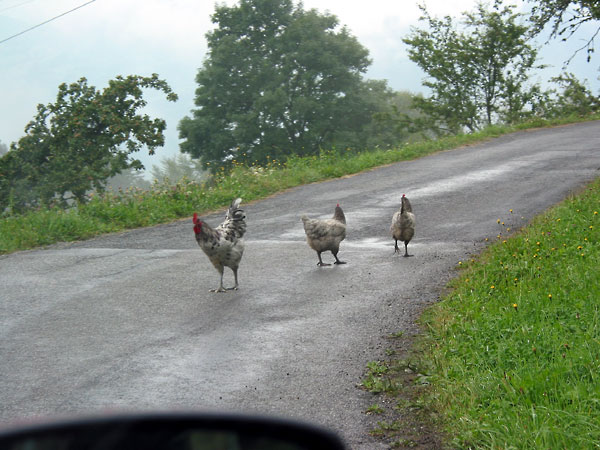
The extra attention that a motorcyclist is used to pay to the situation will probably keep these chickens alive as well.
Driving is a kind of team activity, but the team is not always very well spirited, nor is it a close knit team. Yet even so each of us must regard the needs of other road users as being as important as our own, since we all need to make journeys and that others have as much right to use the roads as we do. Being late for work is not a reason to endanger other people.
Primary safety
Enhancing your primary safety means:
- watching your condition (and your motorcycle's)
- look and know what you cannot see: anticipate
- practice braking
- practice swerving
- create space
Active safety: Watch your condition (and your motorcycle's)
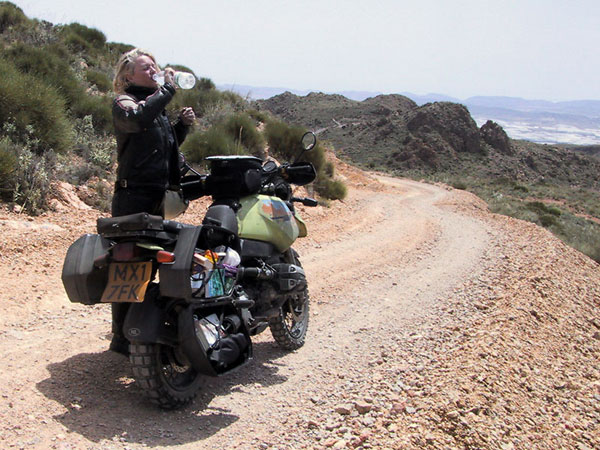
Condition of your motorcycle
Of course, you make sure your motorcycle is working properly: it shouldn't give you nasty surprises when you are underway, the brake pads shouldn't be worn out, the lights should be working, the tire pressure should be right, etc.
But accidents caused by motorcycle defects hardly occur (see item 8 of the crash statistics).
Items 1 and 2 of the statistics show that attention failure is an important ingredient in many accidents. And when you consider 3 and 4, and realize that motorcyclists should foresee what can happen and anticipate, you will realize that your attention is of great value.
Your own condition
That means that it is very important that you:
- keep yourself in good shape
- eat in time (especially important on a long trip!)
- drink in time (the same, and especially important in hot weather)
- observe whether you are (too) tired
- keep yourself comfortable (dry, not too hot, not too cold)
- are not hungover, there will still be alcohol in your brain
- don't be drunk or high
- don't be on powerful or affecting medication
- don't ride with the flu and be very careful even with a head cold
- forget about all your everyday or not so everyday problems
This might seem superfluous to say, but many people forget how important these issues are. Especially the last item is often overlooked!
Think about the reward when you keep that item in mind: it gives you the bonus of being there, in a Zen-like way, of being a motorcycle rider and nothing else.
Active safety: Look and predict what you cannot see: anticipate
Mistakes of others
It is clear from the statistics (especially item 3) that it is very important to anticipate on errors of others.
Attention to what you can't see
An extra point of attention is to be very conscious of what you don't see (see item 4).
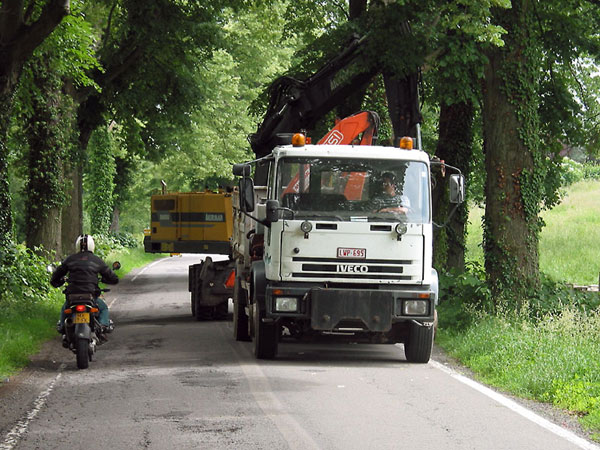
So be very alert when you see a truck at the side of the road (which can block your view on
playing children or on a side street), on trucks that you pass (in stop 'n go traffic for instance)
and of course when passing before a corner.
Be also alert for "dips", stretches of the road that are below your point of view.
Try to build a sort of list of those kind of situations, where something may be hided.
Active safety: Practice braking
Emergency brake
When anticipation didn't succeed, or you didn't notice a hidden danger, you sometimes come
into a situation where an accident would happen when you wouldn't act.
In many cases, braking may save you.
Most people cannot, by far, brake as hard as their motorcycle could.
Practise, practise, practise!
Braking, grip, weight
Braking has to do with grip, and grip has to do with your tires and the weight
that presses on the tires.
The more weight on a tire, and the stickier the tire, the harder you can brake.
Therefore, the weight of the motorcycle itself doesn't matter: on a lighter motorcycle, the
tires have to do less work to bring the motorcycle to a stand-still, but at the same time,
the lesser weight makes that the tires *cannot* work as hard as on a heavier motorcycle.
So, the weight of the motorcycle itself doesn't matter, but the distribution of the weight does.
On a downward slope you only have to touch the rear brake slightly before the rear wheel locks:
there is so little weight on the rear wheel that a little bit of braking stops it completely.
Technique for an emergency brake
During braking, you sort of have the same situation: the weight "travels" to the front wheel.
For most motorcycles (except for cruisers and long touring machines), the technique is therefore as follows:
1.- pull the clutch (so your rear wheel is no longer engagaed, and can't "push" the motorcycle anymore)
2.- stay away from the rear brake (when you brake hard, all the weight is on the front wheel; that means that trying to brake with the rear brake will inevitably result in a locked rearwheel, and you don't want that)
3.- start with using the front brake, to "prepare" your motorcycle for braking, and then Pull. Practise and pull harder, until you hear a tiny whining noise from your front tire. Then, you brake at the maximum. You really can pull hard!
4.- In case of a light (sports-) bike, take care for stoppies (which means that the rear wheel lifts from the ground). In case of an unwanted stoppie, gently loosen the front brake (so don't let go abruptly).
Cruisers: the rear brake as well
Cruisers and long touring machines should use their rear brake as well: they don't get all the weight on the front wheel during braking, so the rear brake really helps there.
Practise
You might consider to practise using the rear brake slightly when you start braking.
It helps preparing the motorcycle for hard braking. After the start of the braking,
you let go of the rear brake.
The problem is that using the rear brake then becomes a habit which you will also do in an emergency
situation, and in such a situation it is very hard to let that brake go.
Braking in a corner
Definitely practise braking in a corner!
The procedure is the same, but you also have to push your motorcycle into the curve while braking
(with your knee, and by pushing with your left hand in a corner to the left, or
your right hand in a corner to the right, to the handlebar; you can read more
about it on the page about cornering). Of course, you can't
brake as hard as on a straight, but you still can brake harder than you would think if you never practised.
Active safety: ABS
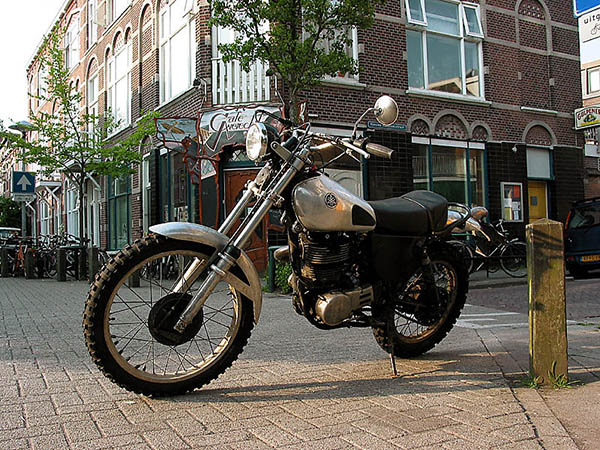
And what about ABS?
No locked wheels
The idea of ABS is that you are ensured not to get a locked wheel during braking.
It seems ideal, but there are disadvantages as well:
Sometimes disadvantages
- Some tests show that ABS performs better, but some tests have other results, and the experience of some people is also different: some ABSses engage before the point of maximum braking.
- When the surface is bumpy, ABS will sometimes engage too soon: it gets disturbed. That means scary moments on roads with bad surfaces (in the mountains for instance), because you suddenly have no brakes.
- In loose gravel, sand, grass, or any of such surfaces, ABS prevents you from braking at all. You can switch off the ABS of a BMW GS, but you have to stop, switch off the contact, and switch it on again. On many other motorcycles, you can't switch off ABS at all.
- Some ABSses have stoppie-intelligence. When they notice that the rear wheel gets too light, the ABS looses the front brake. That means that your front wheel suddenly seems to slide forward while it wasn't near locking at all. Especially going down in the mountains, braking before a corner, it happens regularly, and I can tell, from personal experience, that it feels terrible.
- Most people have a tendency to increase their speed (especially in rainy conditions) when they have ABS (the "I do have ABS, don't I?"-syndrome).
Deciding
You will have to think about how often you find yourself in a situation where the ABS is in your way, and how often you find yourself in a situation where it could save you.
It also depends on how you use your motorcycle: if you often go "into the wild", you might be worse off with ABS.
Always practise
When you choose ABS, don't forget to practise braking (it's very easy to forget practising then!). When you can switch it off, also practise with the ABS switched off.
And never forget that ABS only has advantages for your safety when you ride as though you don't have it!
If you have this tendency of increasing your speed, it only succeeds in diminishing your safety!
Active safety: Practice swerving
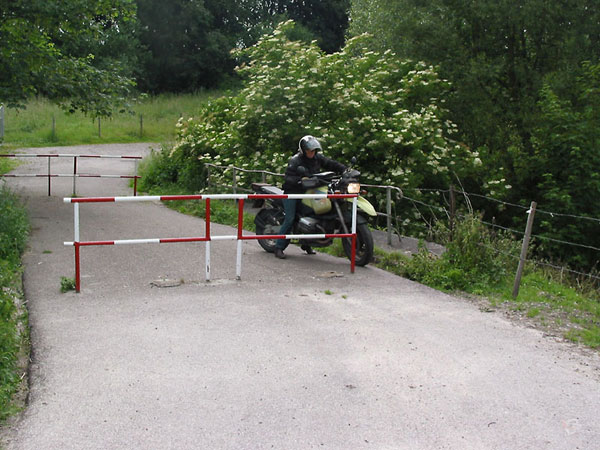
Either swerve or brake
To brake is not the adequate strategy in every situation. Sometimes it is better to swerve
around the obstacle.
It's important to do one thing at a time: either brake or swerve. If you have to do both,
first brake to loose speed, let go of the brakes, and then swerve.
Most advanced rider courses make you practise on this.
Countersteering
You swerve by far the most quickly and efficiently by countersteering.
That means, very simply:
- When you want to swerve to the right, push against your right handlebar.
- When you want to swerve to the left, push against your left handlebar.
Practise
Practise this, especially when you are not familiar with that way of initiating a turn.
It's also very important that you know, from experience, how far you can lean your motorcycle
into a turn. That you know exactly how far you can go in a given situation.
Like in the case of braking, there are not only accidents that could have been prevented by braking
harder or by leaning more, but also accidents that are caused by braking too hard or leaning too far.
To get a feeling for your motorcycle in curves, a vacation in the mountains is an ideal training, as is, of course, an advanced riding course on a circuit.
Active safety: Create space
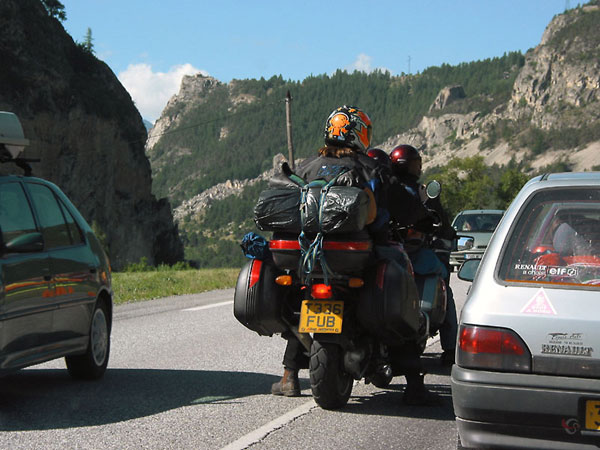
Space for extra margin of safety
Another way to increase your own safety is to realise that you are responsible to maintain space around you.
You may use that space to have room to brake, to swerve, or just as extra time to decide what to do.
Keeping space around you is something that is easily forgotten, especially when you are trying to pass a truck. But even then, passing is done more easily when you maintain distance between you and the truck, until the point that you can accelerate to pass.
It's *your* space, and you can use it in an emergency, so look well after it...
Comments, Q & A, on a separate page